Naxos is the island most visitors arrive at expecting a quieter Mykonos and leave wondering why anyone goes anywhere else. It is larger, greener, older, and better-fed than anything nearby — with more archaeological sites than staff to manage them, beaches long enough to lose yourself on, mountains high enough to hike properly, and a food culture rooted in actual agriculture rather than tourism. These twenty things come from people who drive every road on this island every day.
Watch the Portara at sunset
The Portara is a single colossal marble doorway standing on a rocky islet connected to Naxos port by a stone causeway. Construction began around 530 BC under the tyrant Lygdamis, who intended it as the entrance to one of the largest temples in the Aegean. When his rule ended, the builders walked away and never returned. The gateway has stood there for 2,500 years without a roof, without walls, without the temple it was meant to announce — just two massive columns and a lintel, framing a rectangle of sky above the Aegean.
At sunset the stone turns amber, the sky behind it cycles through every shade of gold, and half the island is watching. Come early to claim your spot — locals bring wine and cheese and treat it like a communal ritual, which in a way it is. Come at dawn instead if you want it to yourself: the light comes from behind the town, catches the marble differently, and you will almost certainly be alone.
Free entry 5 min walk from port Open alwaysWalk the Venetian Kastro
The Kastro is a fortified Venetian hilltop settlement built in 1207 by Marco Sanudo after the Fourth Crusade scattered the remains of the Byzantine world across the Cyclades. It sits above Chora — a walled precinct of narrow alleys, Catholic churches, and towers built deliberately to confuse anyone who had broken through the gates. The carved coats of arms above the doorways are still legible. Twelve Venetian noble families lived inside these walls for three centuries, governing the Duchy of the Archipelago from this windswept hilltop above the Aegean.
The best time is evening, when the lanes are lit and the restaurants inside the walls fill with the sound of Greek conversation rather than tourist commentary. The Della Rocca tower at the northeast corner gives a view over the whole town and the coastline south toward Plaka. The Catholic Cathedral inside the Kastro is still active — one of the few surviving Catholic parishes in the Cyclades, a direct legacy of Venetian rule.
Our full walking guide to Chora covers eight stops through the town, from the fishing port at dawn to the Kastro under the stars: A Walk Through Chora.
Free entry 15 min walk from portThe Temple of Demeter at Sangri
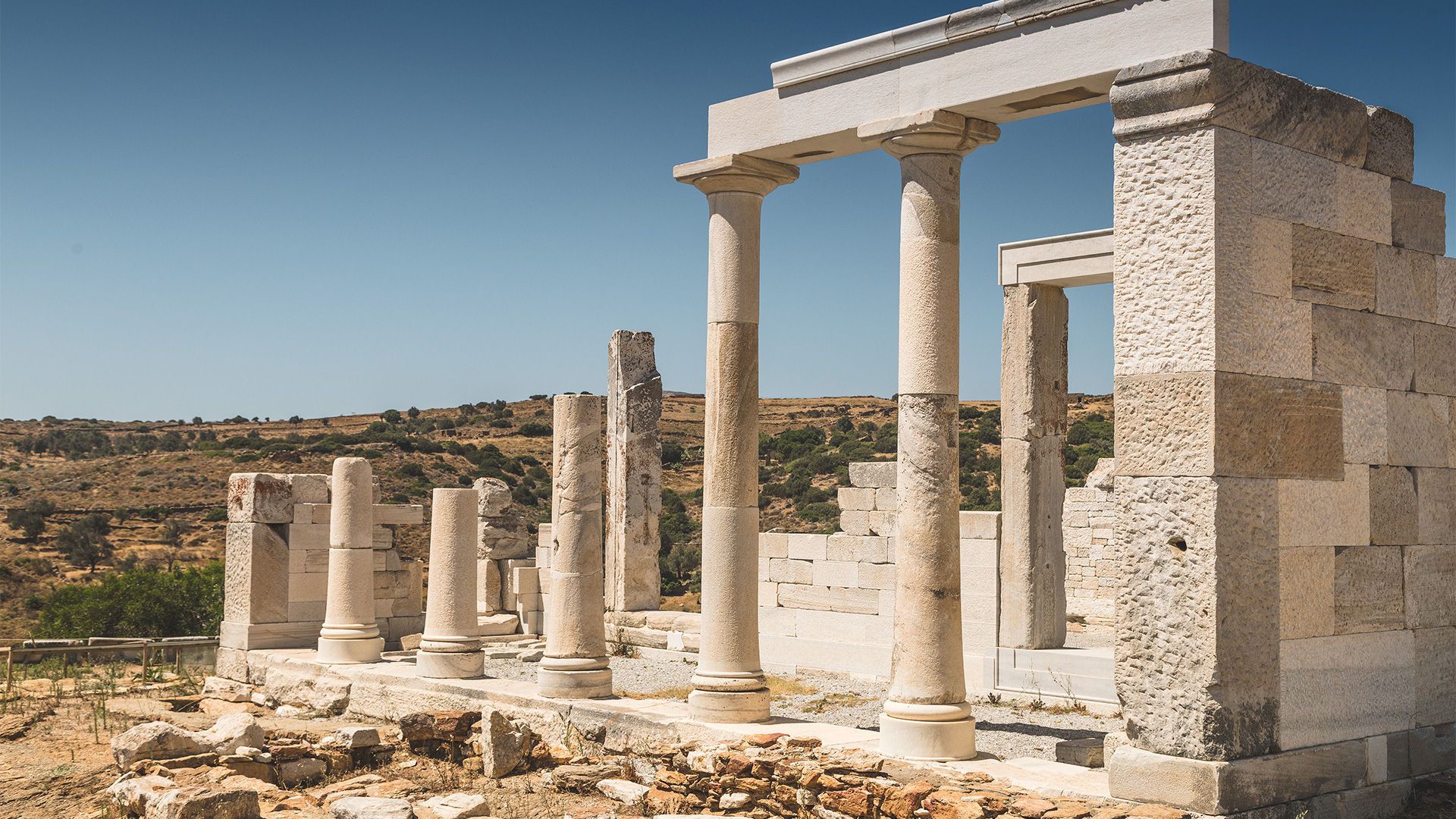
On a hilltop above the village of Ano Sangri, the Temple of Demeter is one of the finest — and least visited — ancient sites in the Cyclades. Built around 530–500 BC entirely from Naxian marble, it was later dismantled and its stones used to build a Christian church, which in turn collapsed. The temple has been carefully reconstructed from the surviving blocks and stands almost complete on its windswept plateau, the agricultural plain spreading south below it.
The small on-site museum is exceptional for its size — detailed models show the original structure, and finds from the excavation give the site genuine archaeological weight. Most visitors to Naxos never come here. The site is 13km south of Chora on a good road, takes around an hour to visit properly, and is usually entirely empty. It is part of our full guide to the archaeological sites of Naxos and a stop on our Ancient Naxos guided tour.
Small entry fee 13km from Chora On-site museumFind the Kouros of Flerio
In an olive grove in the Melanes valley, a 6th-century BC marble statue lies exactly where the sculptors abandoned it — face-up in the earth, 5.5 metres long, still attached at the lower legs to the bedrock it was being carved from. The reason for the abandonment is unknown. A crack appeared, the commission was cancelled, or the sculptor died. Whatever the reason, the craftsmen walked away and the kouros stayed.
The five-minute walk from the signed car park takes you through a working olive grove that has been cultivated continuously since antiquity. The statue is so large it takes a moment to register what you're looking at. There is nothing between you and it — no barrier, no platform, no interpretive panel that blocks the experience of standing next to a 2,600-year-old unfinished giant lying in an orchard. This is one of the best things on the island and is listed in our Hidden Naxos guide.
Small entry fee 9km from Chora 5 min walk from parkingPanagia Drossiani
On the road between Moni and Halki, half-hidden in the olive groves, the Panagia Drossiani is one of the oldest surviving Byzantine churches in Greece — parts of it date to the 7th century AD. The interior contains original frescoes that have survived on the curved walls of the nave since the early medieval period, in colours that still hold a quality of warmth and presence that later, better-preserved Byzantine art sometimes lacks.
The church is small and unannounced on the landscape — a dome barely visible above the grove, a small hand-painted sign on the road. It is kept by a local guardian who opens it during daytime hours. Visiting it as part of a Tragaea driving circuit — Halki, Moni, Filoti — is the natural context, but it also rewards the deliberate detour on its own terms.
Free / donation Near Moni village Open daytime hoursThe Archaeological Museum in the Kastro
Located in the upper floors of a former Jesuit school inside the Kastro, the Archaeological Museum of Naxos holds one of the finest collections of Cycladic art in Greece — marble figurines from the 3rd millennium BC, pottery spanning the Geometric to Roman periods, and finds from the island's major excavations including the sanctuary at Iria and the Naxian quarries. The Cycladic figurines alone justify the visit: these abstract marble forms, carved between 3200 and 2000 BC, are the direct ancestors of the modernist sculpture you see in every major museum in the world.
Entry fee Inside the Kastro Closed MondaysSee the Kouros, Demeter, and Iria with a local guide
Drive the Tragaea villages
The Tragaea is the largest olive grove in the Cyclades — a plateau in the island's interior ringed by mountains and scattered with Byzantine towers, Venetian farmhouses, and villages that have been continuously inhabited since antiquity. The road that connects Halki, Filoti, Moni, and Apiranthos is one of the finest drives in the Aegean: narrow tarmac through ancient olive canopy, with the sea appearing unexpectedly through gaps in the terrain as you climb.
Halki is the first village — a small Venetian-influenced settlement with a beautiful main square, the Vallindras Kitron distillery, and the Panagia Protothronos church. Filoti, the largest inland village, sits at the foot of Mount Zas and has good tavernas. Moni is quieter and older-feeling, a few hundred metres off the main road. Apiranthos is the one that stops people in their tracks: white marble streets, carved stone façades, a local accent that differs from the rest of the island, and the specific unhurried pace of a village that has been doing exactly this for a very long time.
Our full guide to the villages: The Mountain Villages of Naxos.
Car or private tour required Half-day minimumSpend a morning in Apiranthos
Apiranthos deserves separate mention from the village circuit. It sits higher than the other Tragaea villages — on a shoulder of the mountain, with views east over the emery mines and the Aegean beyond. The streets are entirely paved in white marble quarried locally. The houses are built from the same grey-white stone. There are no cars in the main alley — it is too narrow and too old for them.
The village has an unusual intellectual history: it produced a disproportionate number of scholars, a fact celebrated in the four small local museums (archaeology, natural history, Cycladic art, and folklore). The kafeneion on the main square operates on a schedule set by the village, not by tourism. Arrive for a coffee at 9am on a weekday in May and you will share the terrace with retired farmers discussing local politics in an accent that sounds nothing like Athenian Greek. This is the real Naxos interior.
Car or private tour required 28km from ChoraThe Eggares Olive Press Museum
The olive press at Eggares, 6km north of Chora, operated continuously from the early 19th century until the 1960s. It has been preserved exactly as it was when production stopped — the stone mills, the pressing beams, the storage jars, the whole mechanical chain from olive to oil — and turned into one of the most engaging small museums in the Cyclades. The guide explains the process in detail and the building itself is beautiful: thick stone walls, wooden beams, the smell of old olive wood.
It is a stop on our Village Tour for exactly this reason — it explains something fundamental about how Naxos has sustained itself for centuries that no beach or ruin can tell you. The drive from Chora to Eggares also takes you through the narrowest and most beautiful section of the olive grove approach to the Tragaea.
Entry fee 6km from ChoraTry kitron at Vallindras Distillery
Kitron is a sweet liqueur made from the leaves of the citron tree — a variety that grows on Naxos and almost nowhere else in Greece. Vallindras, in the centre of Halki, has been producing it since 1896. The distillery is open for tastings, and the building — original copper stills, wooden shelves of bottled stock, a production room that smells of citrus and warm spirit — is worth seeing in its own right. Kitron comes in three strengths and colours: green (strongest, driest), yellow (medium), and clear (sweet, the one most visitors prefer). You cannot buy it outside Naxos. It is the correct way to end a Tragaea circuit.
Free tasting Halki village centre Open daily in seasonWalk Plaka beach in the early morning
Plaka is the longest continuous stretch of sand on the island — around 5 kilometres of fine white sand and dunes running south from Agia Anna, backed by low scrub and accessible from multiple entry points along a coastal road. In July and August it fills up, but never to the density of the more famous Cycladic beaches because the sheer length of it disperses the crowd. In May, September, or before 8am in any season, it is essentially yours.
The southern end of Plaka, where the sand becomes wider and the dunes taller, is the quietest. The sea is shallow for a long way out and the colour — over white sand in clean water — is the specific Cycladic turquoise that justifies every photograph you've ever seen of the Greek islands. Our full Naxos beach guide covers Plaka and four others in detail.
Free Bus accessible in seasonSwim at Alyko cedar forest
The Alyko peninsula in the southwest of the island is one of the most unusual landscapes in the Cyclades: a protected cedar and juniper forest on coastal dunes, with coves of clear water cut into the headland on either side. The trees grow directly out of the sand and have shaped the dunes around them over centuries. The water here is deeply sheltered from the north wind and unusually clear even by Naxian standards.
There are no beach bars, no sunbeds, no organised facilities of any kind. This is deliberate — the area is environmentally protected. Bring your own water, arrive early for shade, and spend an afternoon in a place that looks the same as it did a hundred years ago. The eastern cove (toward Hawaii Beach) is the most sheltered and the water is the calmest.
Free Car required Protected area — no facilitiesWatch the kitesurfers at Mikri Vigla
Mikri Vigla is a world-class kitesurfing and windsurfing spot — consistently ranked among the best in Europe, and the best in Greece without qualification. The Meltemi winds funnel through the channel between Naxos and Paros with particular consistency here, and the water is relatively flat, making it ideal for learning and for high-level performance. Several professional kitesurfers use it as a training base in summer.
You do not need to participate to appreciate it. Watching a dozen kites working the same stretch of water in the late afternoon Meltemi — the colour of them against the Aegean blue, the speed of it — is a spectacle. There is a taverna above the beach with a terrace that is possibly the best seat in the house. Lessons are available through operators on the beach for anyone who wants to try.
Spectator: free Best Jul–Aug for wind Car requiredEat Naxian food properly
Naxos is the most agriculturally productive island in the Cyclades and it shows on every plate. The island produces its own beef and pork, its own potatoes (famous across Greece — grown in volcanic soil, with an earthiness that is immediately noticeable), its own graviera cheese (a semi-hard cheese with a slightly nutty sweetness, exported across Greece and recognised with PDO status), and its own wine from vineyards in the Tragaea and around Halki.
What to order: Graviera saganaki (grilled Naxian cheese, ideally with local honey). Naxian potatoes in any form. Patoudo — lamb stuffed with rice, herbs, and liver, slow-cooked, a dish you will not find anywhere else. Fresh fish from the morning boats at Agia Anna or Apollonas. Loukoumades (honey fritters) from the stalls in Chora that have been making them the same way for decades.
Where to eat: In Chora, Axiotissa is considered the finest table on the island for Greek cuisine with a contemporary edge — book four to five days ahead. For something more local and less formal, any of the tavernas in Halki or Filoti on a weekday afternoon, when the kitchen is cooking for the village rather than for tourism. In Apollonas on the north coast, the fish tavernas on the harbour serve the morning catch directly — sea urchin, octopus, fresh grilled fish — with a view of the water and almost no tourists.
Axiotissa — book ahead Halki tavernas — no booking neededThe Friday market in Chora
The weekly market near the Naxos port runs on Friday mornings. In shoulder season it is staffed almost entirely by the people who produce what they're selling — honey from the Tragaea, dried herbs from the mountain villages, Naxian graviera direct from the dairy, preserved olives, local wine. It is the most direct way to buy something that is genuinely from this island and from this week rather than from a supply chain. In July and August the balance shifts toward more tourist-facing products, but the core producers are still there early in the morning.
Friday mornings Near the port Cash usefulHike Mount Zas
Mount Zas — Zeus — is the highest peak in the Cyclades at 1,001 metres. According to mythology, Zeus was raised in a cave on this mountain, hidden from his father Cronos. The cave is still there and is passed on the main trail. The summit gives a panoramic view of the entire island and, on clear days, of Paros, Syros, Mykonos, and the outline of Santorini to the south.
The standard route begins from Filoti village, climbs through oak and juniper forest, passes the cave of Zeus, and reaches the summit in around 2–3 hours depending on pace. The trail is well-marked and manageable for anyone in reasonable fitness. The conditions window is April to June and September to October — in July and August the mountain is dry, exposed, and too hot to climb safely above the treeline by mid-morning. Wear proper footwear, carry 2 litres of water minimum, and start before 8am in summer.
Free 2–3 hours to summit Start from Filoti Best Apr–Jun, Sep–OctDrive north to Apollonas
The road from Chora to Apollonas on the north coast is one of the best drives in the Cyclades — a 37km route that climbs from the coast into the mountainous interior, passes through Koronos (a remote and largely untouched village at 600m altitude), and descends back to sea level at Apollonas, a small fishing harbour with a pebble beach, a handful of fish tavernas, and very few tourists even in peak season.
In the hillside above Apollonas, a second kouros lies in the quarry where it was abandoned in antiquity — this one larger than the Melanes kouros, at 10.5 metres, still partially attached to the marble face from which it was being cut. The drive alone justifies the journey: the views from the mountain roads down toward the Aegean are extraordinary, and the landscape in the north of the island is noticeably wilder and less developed than the south.
Car required Half-day from Chora Second kouros above the villageDay trip to Koufonisia
The Small Cyclades — the chain of tiny islands between Naxos and Amorgos — are among the most beautiful and least-known places in the Aegean. Koufonisia, the most accessible of them, is a 45-minute ferry ride from Naxos port. The island is flat, almost entirely car-free, and has beaches — particularly Pori on the east coast — that rival anything in the Cyclades in terms of water clarity and colour.
A day trip works well: take the morning ferry, spend the day on the beaches and the harbour village, eat fresh fish for lunch, and return in the late afternoon. The island is genuinely small — you can walk across it in under an hour. In July and August Koufonisia becomes fashionable and fills with day-trippers; in June or September it is calm and strikingly beautiful. Check ferry schedules from Naxos port before planning — connections are good in summer, reduced in shoulder season.
Ferry from Naxos port 45 min crossing Full day recommendedTake a private guided island tour
We run two half-day private tours that cover the island's two main inland circuits — the villages and the ancient sites — in a private vehicle with your group only. No shared bus, no fixed group, no rushing through sites to keep a schedule set by someone else's interests.
The Village Tour covers Sagri, Halki (including the Vallindras Kitron distillery), Filoti, and Apiranthos — the Tragaea circuit in roughly four hours, with time to walk the marble streets and have a coffee in the village square. The Ancient Naxos Tour follows the Olive Road through Eggares (the olive press museum), Iria (Temple of Dionysus), Melanes (Kouros of Flerio), Halki, and Sagri (Temple of Demeter) — covering in one morning what most visitors piece together imperfectly over three days with a rental car and unreliable GPS.
Both tours depart at 8:30 AM — when the morning light on the Tragaea is at its best and the villages are still quiet. Full details and booking at our tours page.
Private — your group only Departs 8:30 AM Half-day · Fixed priceArrive properly — private transfer from JNX
Everything on this list starts with getting to the island and getting to your accommodation without the first hour setting the wrong tone. Naxos Airport (JNX) is a small regional terminal 3.5km from Chora. The taxi rank is unreliable for evening and early morning arrivals, and the rental car desk queue after a long journey from the US via Athens is nobody's idea of a beginning.
We provide fixed-price private transfers from JNX to every hotel, villa, and beach on the island — with meet and greet at arrivals holding your name, automatic flight tracking so we are there regardless of delays, and all luggage included. Jeep Renegade for couples, Mercedes Vito for families up to 8, Mercedes Sprinter for groups up to 12. See all prices and destinations.
Fixed price Flight tracking Available 24/7 All island destinationsReady to explore the island?
We'll get you there and show you around.
Private airport transfers from JNX, fixed price to any destination on the island. Half-day guided tours to the villages and ancient sites — your group only, departs 8:30 AM. Available 24/7, all year round.
